

The Hidden Leverage in Your Burger
Because you can’t grill gold, but you can hedge with beef.

Word to the Reader
Markets hand us plenty of noise, my job is to find value and then judge whether the crowd has lost its mind. Right now the crowd is marching behind gold. Every guru, podcaster and self-appointed oracle is shouting “buy bullion” as if the secret to wealth was hiding in a bar of metal you can’t even eat.
Meanwhile, beef, yes, actual beef, has been quietly outperforming the market. The difference with gold is that you can grill the hedge if your portfolio doesn’t need it anymore.
This piece will show you the data, the cycles and the fundamentals. We’ll look at why cattle is not just another commodity but a necessity with structural demand behind it, why cattle prices have real staying power and why beef deserves a place in the investment conversation.
And because research without practice is just academic exercise, I’ll also show you how to get exposure if you live in the euro area through Trade Republic, complete with their quirky offers:
€20 of a random high grade stock for new accounts,
and a 1% cash back on every future purchase.
Think of it as euro-cost averaging into beef average.
A quick note about myself:
I’ve worked with banks that hedge commodities for clients and I’ve seen how the big players treat cattle, corn, energy and metals. What I’m sharing here is not theory, but practice, with a slice of humour on the side.
So settle in, judge for yourself and remember: you can’t eat gold, but you can profit from cattle.
Executive Summary
This article examines cattle as an investable asset class, comparing it with gold and the S&P 500. The results are unambiguous: cattle is the quiet out-performer, stronger than equities in the long run, less volatile and with the highest risk-adjusted returns. Gold remains the crisis hedge, but cattle is the enduring one.
Key findings (25 years):
Total returns: Gold 9,42x, Cattle 3,7x, S&P 500 3.47x.
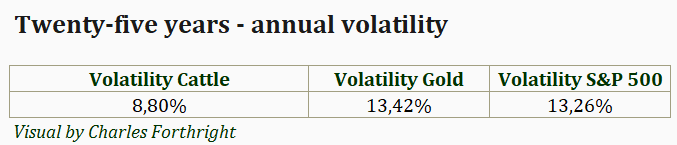
Volatility (annualised): Gold 13,42%, Cattle 8,8%, S&P 500 13,26%.
Sharpe ratio: Gold 16,7, Cattle 14,98, S&P 500 9,51.
Correlations: Cattle-to-S&P ≈7%, Cattle-to-Gold ≈0%, Gold-to-S&P ≈–2%.
Short-term (last 5 years):
Equities outpaced cattle, but cattle’s low volatility makes leverage efficient. Leveraging cattle by 69% to match S&P volatility produced higher returns and a stronger Sharpe. Even a modest 52% leverage matched S&P returns at only 10,4% volatility.
Structural outlook: demand for protein is rising, farmland is scarce and ESG pressures constrain supply. The net effect is clear: upward pressure on beef prices over time.
Core message: cattle is not glamorous, but it is better. It beat equities in the long run, carries less risk and offers real diversification. Gold hedges panic; cattle hedges life.
The detailed quantitative analysis and ESG case follow below. For investors in Europe, exposure is accessible through the WisdomTree Live Cattle ETC (ISIN GB00B15KY096), available on Trade Republic with savings plans, 1% cash back and a free blue-chip stock on sign-up.
These pages are not written lightly. Research is time, and time, like pasture, is finite. Should you find in this work some measure of insight, some steer worth keeping, then know that even a humble gesture sustains the effort.
A small offering keeps the pen moving, as the rancher’s herd keeps the table full.
Market Context: Gold Mania vs Ignored Beef
Gold has fans. In fact, it has disciples. In line with past market cycles, 2025 has turned into another crusade where every strategist, influencer and social media prophet is preaching salvation in bullion. The headlines are shiny, the charts sparkle and if you believe the noise, your only path to safety is a bar of metal that sits in a vault and does absolutely nothing. (Reuters, Sept 2025; Business Insider, Sept 2025)
The pitch is familiar: the Fed will cut rates, the dollar will weaken, central banks are buying and so the story goes. (CME Group, 2025) Gold shines, but mostly in PowerPoint decks and at the wrist of the corporatist that wrote them. You can’t eat it, you can’t heat your house with it and unless you plan to build a rocket, you can’t propel yourself to Mars with it either. If you are the kind of person who does not see himself flying to Mars in a Tesla propelled by gold bullion, then keep reading.
Because there is another hedge, quieter, humbler, unglamorous. Cattle. No network puts “Breaking News: Ribs Rally” on screen. Ranchers don’t host flashy investor days. Yet beef is consumed daily, in every country, by people who couldn’t care less about central bank policy. Herd cycles take years, supply is slow to adjust and demand for protein does not go out of fashion when bond yields move.
Gold is adored because it looks timeless. But beef has purpose because it is essential. It is a hedge that feeds. Ranchers, not corporatists, influencers or fashion icons, provide something tangible. If society collapses tomorrow, gold and social media posts won’t matter. Dinner will.
Performance Evidence: 25 Years of Returns, Risk and Ratios
The Long-Term: Golden Years
Looking at the past 25 years, the scoreboard seems clear at first glance: gold has outperformed both cattle and the S&P 500.
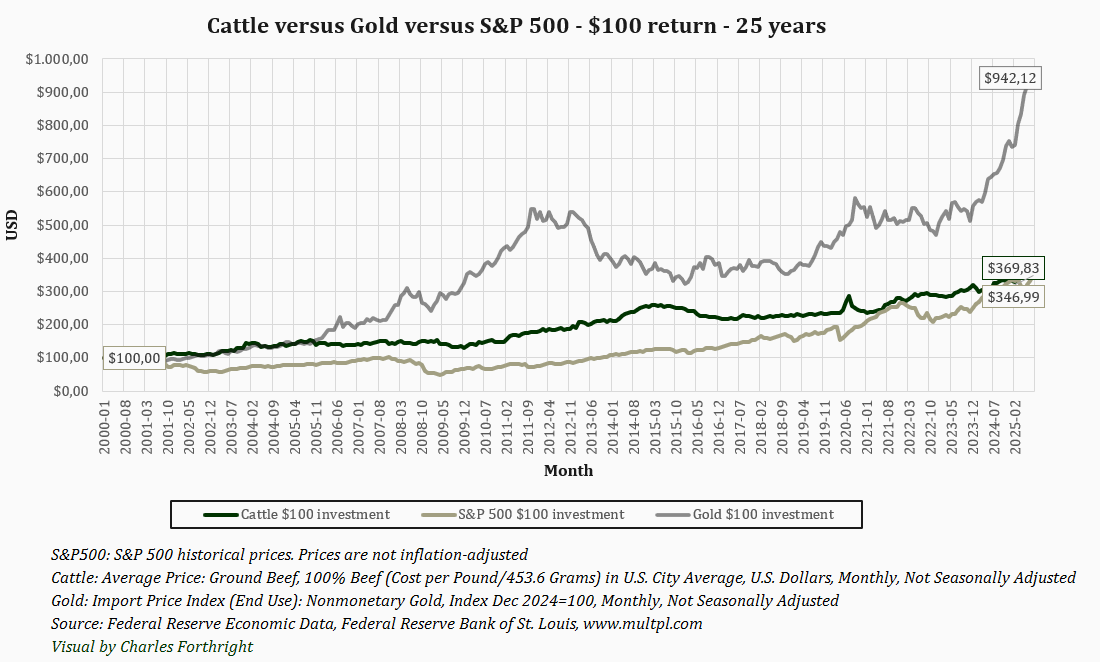
Yet a closer inspection, one that overlays history on the price chart, shows that this outperformance is concentrated in specific windows of turmoil. Gold pulled ahead in 2007 with the housing crisis, stayed ahead through the banking sector’s credibility collapse and extended the lead into 2015 during the eurozone debt crisis. The same pattern repeated in 2020 with COVID and again in 2023 with the Ukraine war and subsequent political turbulence.
In other words, gold outperformance coincides with moments of high uncertainty. This matches the correlation data: gold carries a slightly negative correlation of -2,14% with the S&P 500.

A sweet feature in times of turbulence but it comes at a cost. When markets rally, gold often bleeds.
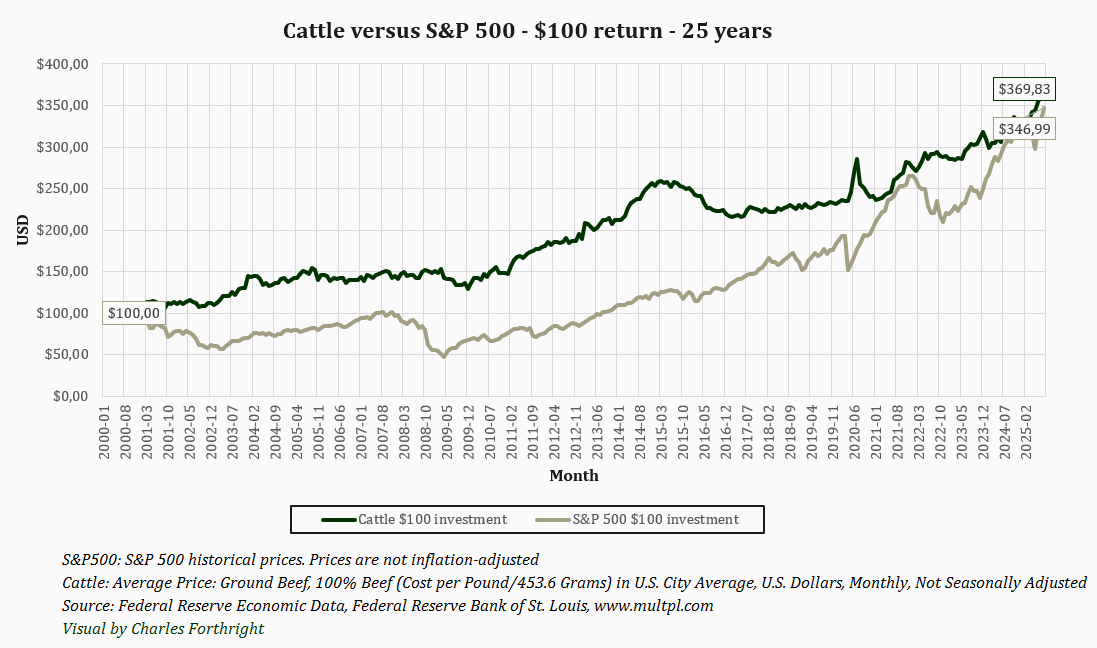
Cattle, by contrast, tells another story. Over the same 25 years, it consistently outperformed the S&P 500. Not in bursts of panic, not in crisis windows, but quietly, steadily, over the entire horizon. It did not top gold in absolute return, but it beat the market’s darlings without drama.
Volatility and Risk
Higher returns usually mean higher risk. Rational markets should reward danger with premium. Yet cattle breaks this rule. Over 25 years, cattle not only returned more than the S&P 500, it did so with the lowest annualised volatility of the three assets.
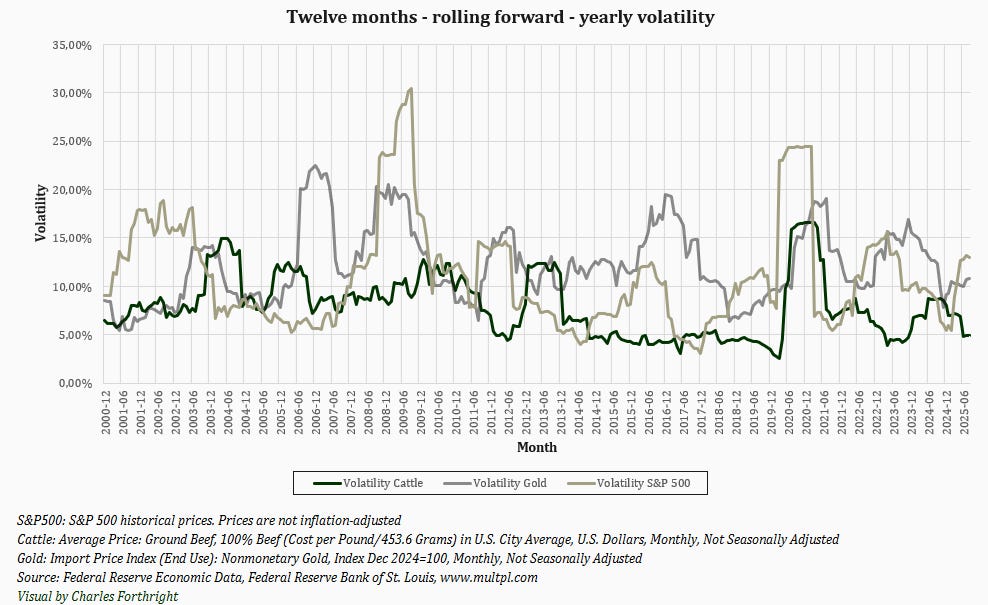
Gold delivered higher returns but at a whopping volatility of 13,42%, a roller-coaster ride, in line with the markets madness, not for the faint-hearted. Cattle delivered superior returns with lower risk at only 8.8% volatility. The S&P 500 in contrast with cattle? More risk, less return, a contradiction in efficient markets and frankly, an embarrassment.
Volatility and return tell only half of the story. One needs to put them together to get the full picture and therefore look at risk-adjusted returns.
To judge whether a return is justified by the risk taken, one can employ the Sharpe Ratio. Defined as:
Where Rp is the portfolio return, Rf the risk-free rate and σp the volatility of portfolio returns.
A higher Sharpe ratio means more return per unit of risk.
Looking across the three assets:
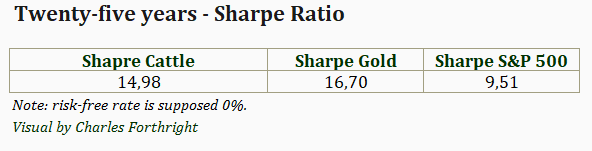
Gold’s Sharpe is impressive, but inflated by those crisis-driven surges.
Cattle’s Sharpe ratio is robust, reflecting steady returns with low volatility.
The S&P 500’s Sharpe is the weakest, a reminder that glamour does not equal efficiency.
Cattle did not eclipse gold in outright return, but it did smoke the equity market and did so with a risk-adjusted profile that should make any portfolio manager question why they worship indexes filled with social media apps and subscription gimmicks.
The Short-Term: Five Years of Silicon Glory
Shift the lens from twenty-five years to just five and the picture changes. The S&P 500 has been the champion, fuelled by tech valuations, liquidity and a constant stream of hype that turned balance sheets into marketing brochures. In this window, equities clearly outpaced both cattle and gold.
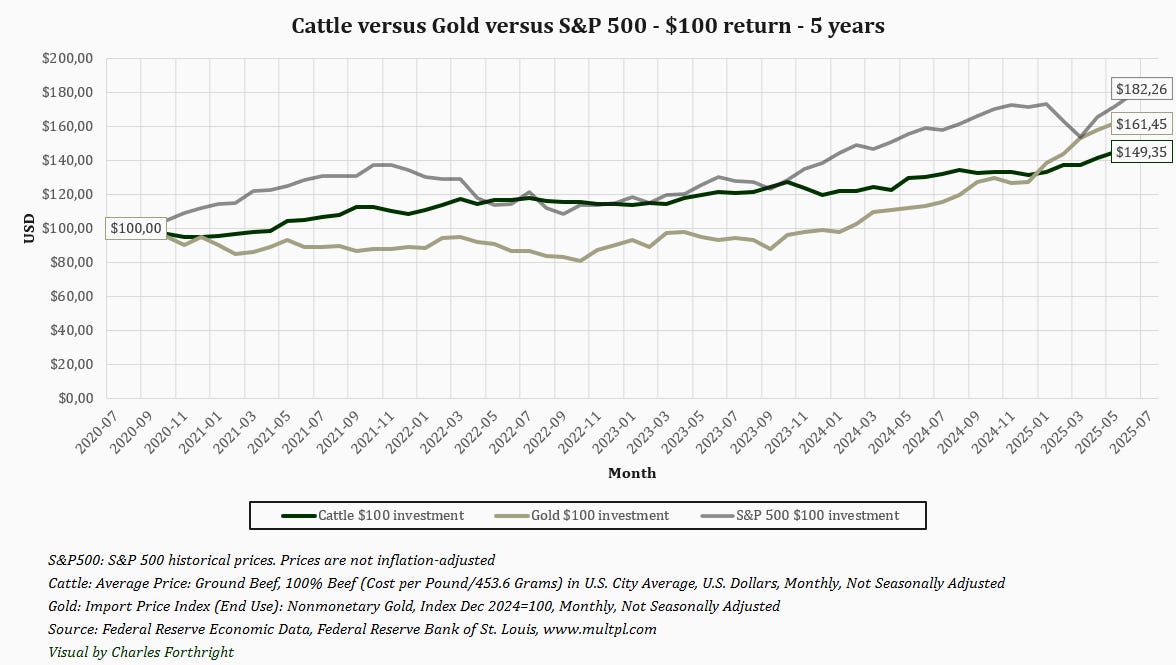
But short horizons can be deceptive. Equity rallies are spectacular, until they aren’t. The very correlation that makes the S&P 500 soar in good times also makes it crash in synchrony when liquidity dries up. Gold, as usual, did its safe-haven act: shining briefly during the Ukraine shock and retreating once the panic eased.
Cattle, on the other hand, remained itself: steady, quiet and boring by Wall Street standards. Its returns trailed the index in this narrow slice of history, but it did so without drama, without collapse and without relying on central bank press conferences to justify its existence. This is reflected in its volatility which is incredibly low, at just 6,84%, or half of the other two products values.
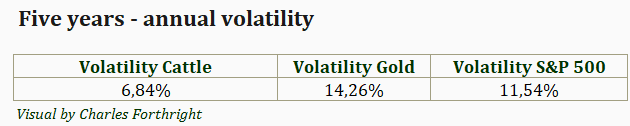
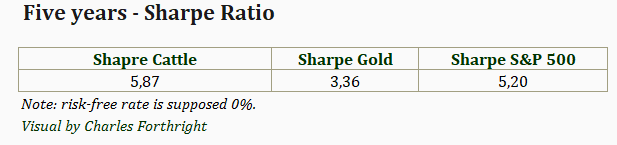
For investors obsessed with quarterly earnings calls and tech headlines, five years looks like proof of the S&P 500’s supremacy. For those who understand volatility, risk and correlation, it is just a reminder that cattle plays a different game, one of patience, low noise and resilience. In fact, looking at the risk adjusted returned, Cattle has outperformed both the S&P 500 and the Gold.
Leverage and the CAPM – Beef with a Boost
Say CAPM in a room of investors and you will hear sighs. The model has been praised, buried and revived more times than a 1990s boy band. Critics complain that it is too academic, too neat, too far from the mess of real markets. Yet the point is simple and it survives every obituary: when you study CAPM alongside the Fama–French research on Beta, the main takeaway is this: low-risk return assets, when leveraged, beat high-risk return assets every day of the week. That is not a quirk, that is the logic of risk.
Banks have known this forever. Borrow cheap, invest in low-risk assets, clip the spread. Done right and with ethics, it is the most basic, yet robust and successful, business model in finance. The trick is not to chase risk, but to magnify stability.

Now apply this to cattle. Over the past five years, cattle lagged the S&P 500 in raw returns. But cattle carried far less volatility. So let us optimise: borrow, add beef and match the volatility of equities.
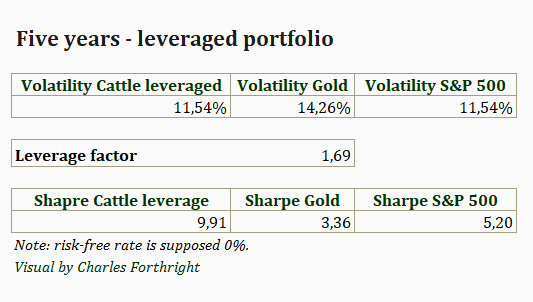
The math is straightforward. To bring cattle’s volatility up to the S&P 500’s level, you would borrow 69% against every dollar invested. One dollar of your own, sixty-nine cents of borrowed cash, all into cattle.
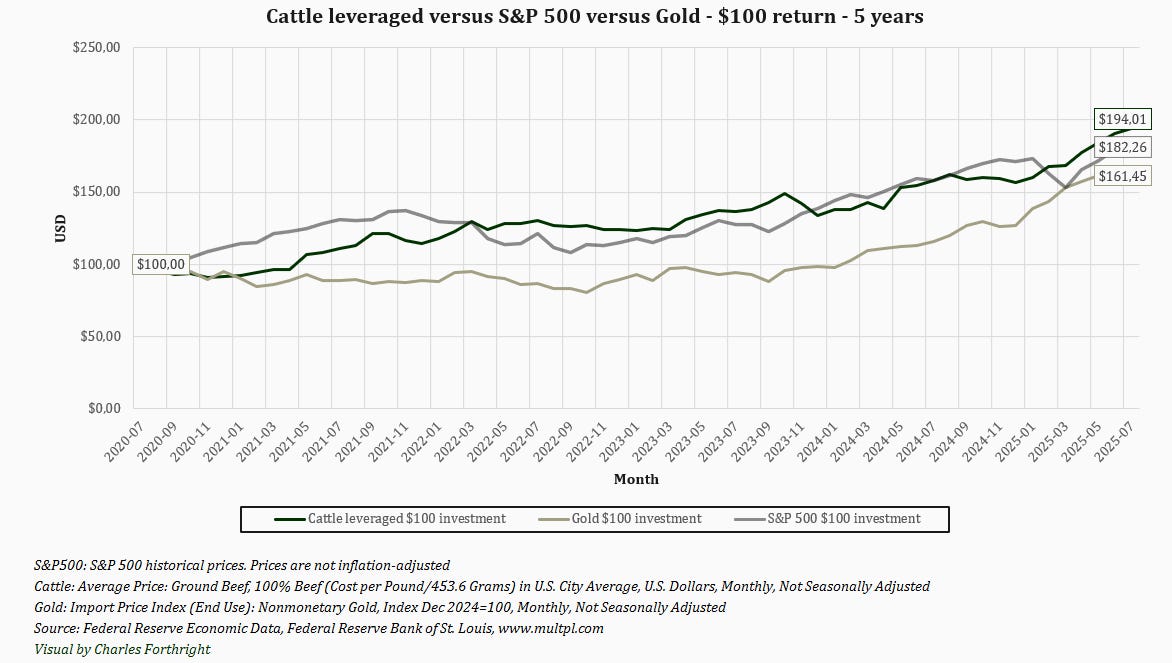
The results speak plainly. Leveraged cattle not only matches the S&P 500’s volatility, it outperforms in both Sharpe ratio and real return. Not by a hair but by a margin, $94 versus $82 total return. The lesson is clear: cattle is market-insensitive. In the long run it beats the market outright; in the short term, if you are impatient, just apply leverage and you still get there.
Even modest leverage is enough. A simple 52% leverage, one dollar of equity, fifty-two cents of debt, would have matched the S&P 500’s return, while still running at a lower risk level, roughly 10,4% volatility. That is not chasing danger, that is designing efficiency.
So the moral is blunt: you can spend your days worshipping the “top 500 corporates” or you can borrow modestly, back cattle and let ranchers do the work. Wall Street sells stories, but ranch boys deliver the beef and with leverage, they deliver the market too.
Sustainability of Cattle: Feeding People, Respecting Planet
In investment circles, sustainability often means greenwash buzzwords. With cattle, it demands a harder look. The meat you see on plates doesn’t arrive by miracle. Behind it lies land, water, feed, emissions and a web of supply chains. Yet without protein, sustainability is just poetic air.
Population Growth, Protein Demand & Scarcity
The world’s population is still climbing. UN forecasts estimate it will crest 9.8 billion by 2050.
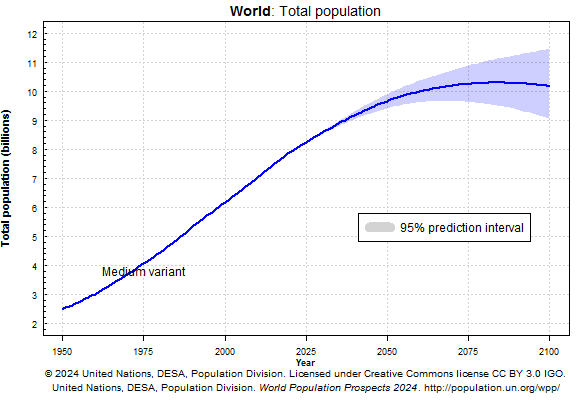
With more mouths to feed, protein demand, especially animal protein, rises disproportionately. World Bank and FAO reports both highlight that as incomes grow in emerging markets, meat consumption increases faster than GDP. World Bank, Food Security & Nutrition | FAO, The Future of Food and Agriculture
Beef, as a high-quality protein (complete amino acids, consumer preference), commands a premium. That demand is sticky. Unlike corn or wheat (susceptible to industrial usage), beef feeds people directly.
Meanwhile, agricultural land is finite. Arable land per capita has shrunk over decades.
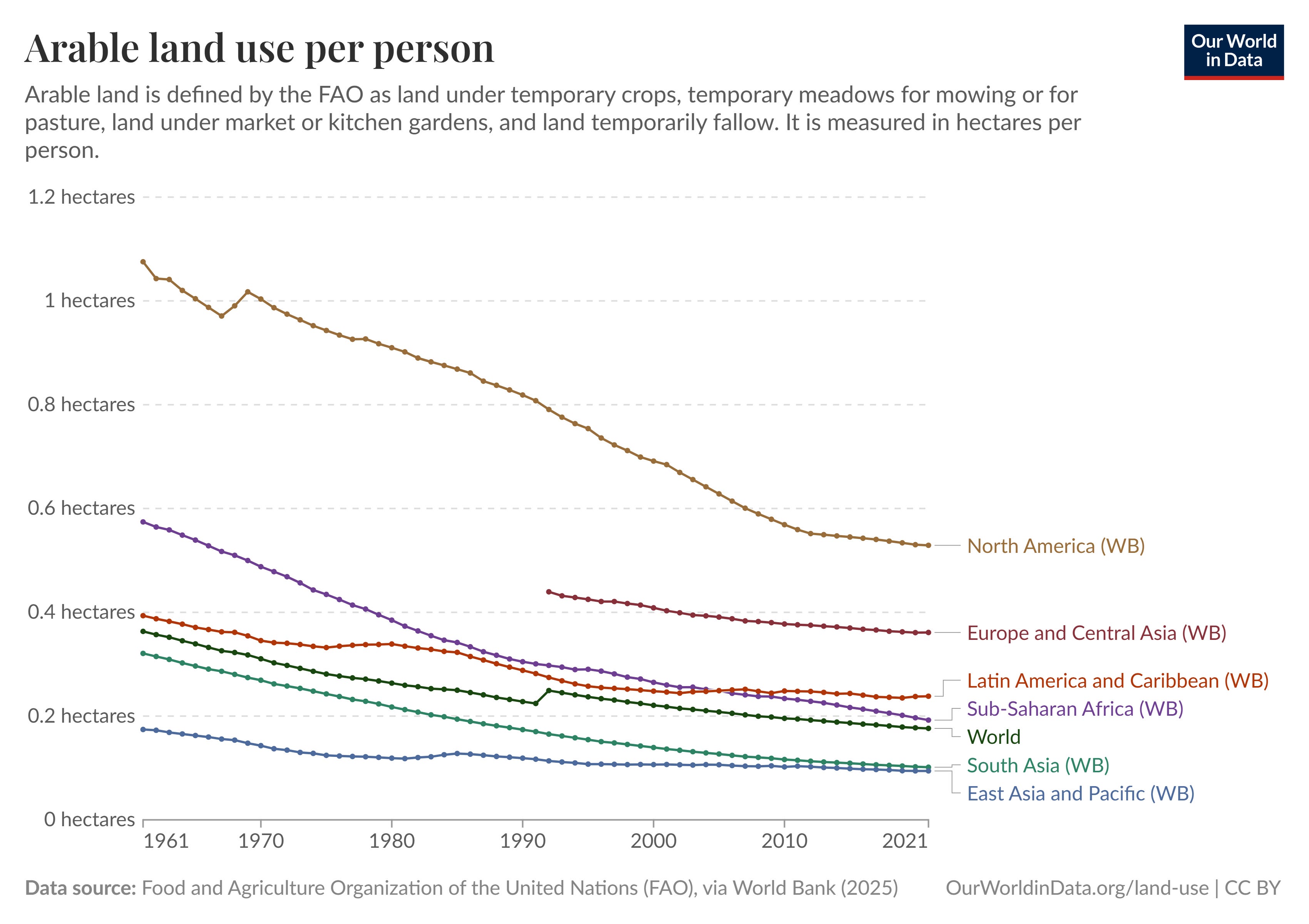
The result: structural scarcity of farmland. Competing demands (biofuels, urbanization) pressure supply.
So the long view: demand pushes up and supply is constrained. Beef is not just another commodity, it sits at the intersection of essential consumption and scarcity. This is a recipe for higher prices.
Emissions, Resource Use & ESG Pressures
Yes, beef production carries carbon, methane, water and land-use impacts. ESG critics point there. The challenge: reconcile environmental cost with the unavoidability of food.
Greenhouse gases / methane: Ruminants produce methane, a potent short-term greenhouse gas. However, scientific studies suggest that improving feed, rotational grazing, feed additives and methane inhibitors can reduce emissions intensity.
Water footprint: Beef requires significant water (for cattle, feed crops). But compare to alternatives: all protein sources consume water. Smarter feed, better irrigation and regenerative practices can reduce water stress.
Land use / deforestation: Deforestation for grazing is a major issue in regions like the Amazon. But many cattle operations are on pasture already cleared historically. Sustainable certifications (e.g. beef from zero-deforestation systems) are emerging.
Animal welfare, ESG certifications, supply-chain traceability: Many producers now offer traceable, grass-fed, certified operations to address consumer and ESG investor concerns.
In balance, ESG is not a fatal flaw, it is an opportunity. Global necessity pushes demand. Whether cattle will become more sustainable or not is unknown at the moment. What is sure is that, in both cases, cattle is a commodity that will become more expensive, either due to the high demand coming from a growing population or a lower supply due to a shrinking production associated with ESG pressures.
Purpose, Resilience and Practical Value
While gold and crypto are stories, cattle is purpose. Ranchers feed communities. In crisis, ranchers matter. Investors linked to real value chains, food, not fashion, hold stronger moral and systemic ground.
From a resilience standpoint, cattle have real optionality: breeding, herd management, feed cellars and vertical integration. They do not collapse into zero when sentiment shifts.
In short: the sustainability case for cattle rests on irreversible demand, improvable emissions practices and the moral logic of feeding people in a fragile world.
How to Put Beef in Your Portfolio
We’ve crunched the numbers, mocked the fantastic 500 and tipped our hats to ranchers. Now comes the only part that matters to your wallet: how to actually invest in cattle. Spoiler, you don’t need a ranch, a feedlot or even a freezer big enough for a side of beef. You just need a brokerage app.
The Vehicle - WisdomTree Live Cattle ETC (GB00B15KY096)
WisdomTree is one of Europe’s largest issuers of commodity exchange-traded products. Their Live Cattle ETC (ISIN GB00B15KY096) tracks Bloomberg’s cattle futures index synthetically via swaps. What that means for you: no margin calls, no rolling contracts, no cowboy hats required.
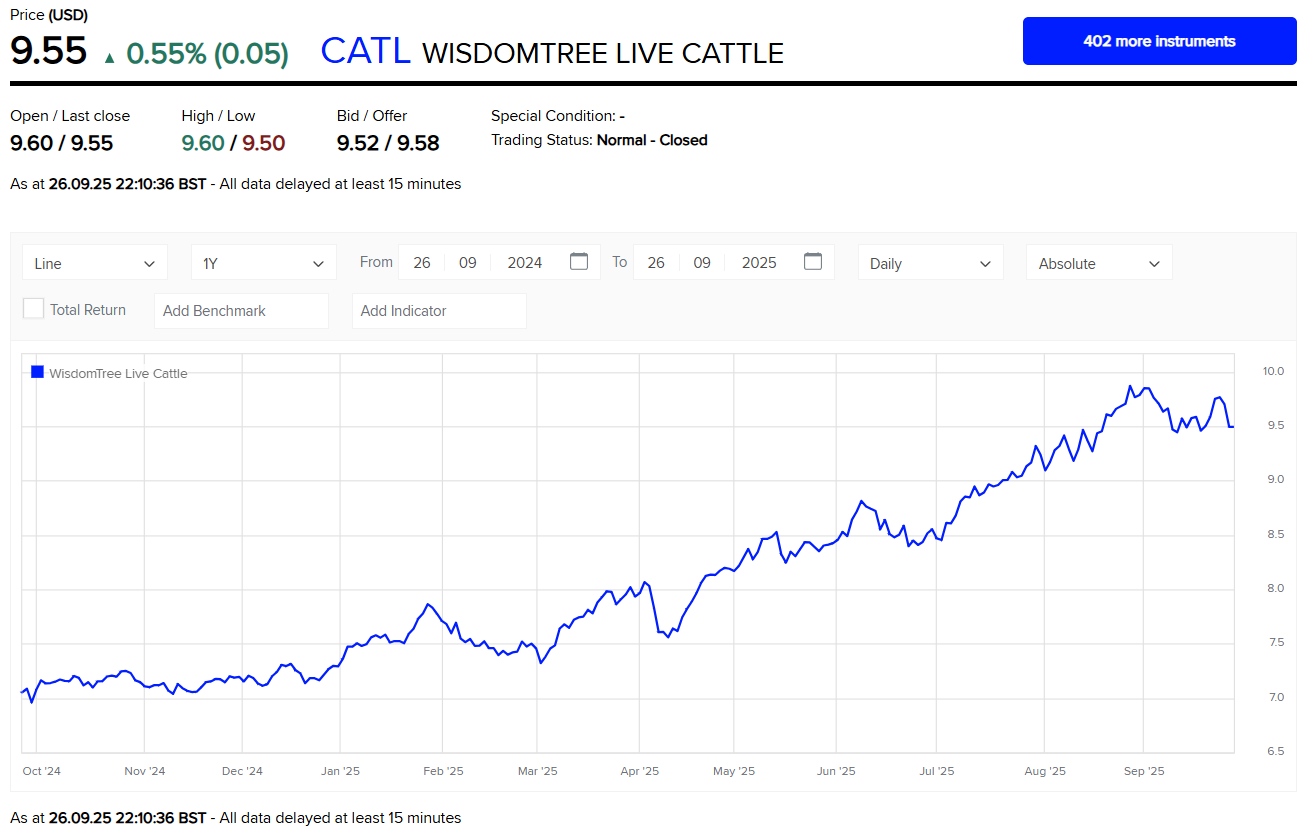
Key facts:
Ticker: CATL (London Stock Exchange).
Replication: synthetic swap on live cattle futures.
Total Expense Ratio: ~0.49% per year.
Currency: USD (so EUR investors carry FX exposure).
Issuer info: WisdomTree Europe | Product factsheet.
This is the cleanest way for Europeans to buy exposure to cattle without going anywhere near commodity market exchange futures.
The Platform - Trade Republic
Trade Republic is a Berlin-based broker that also holds a German banking license. It is supervised by BaFin and the Bundesbank. Cash balances are covered by the €100.000 deposit guarantee and securities are legally segregated from the broker’s own balance sheet.
The appeal is simple:
Low fees: transparent and minimal.
1% cashback: every card purchase gives you money back to reinvest.
Savings plans: automated, recurring investments or as I like to call it here, “beef averaging”.
Get the ECB interest rate on all idle cash, monthly into your account! (wow)
Official site: Trade Republic.
While goldbugs are still stuffing bars under mattresses, you can open an account on your phone in under ten minutes.
The Steps
Here’s how it works in practice:
Register with Trade Republic using a this referral link.
Verify and deposit funds into your account.
Receive a free share: Trade Republic gives you one random high-grade stock (sometimes it’s Netflix, but it could be another blue-chip).
Search for Live Cattle USD.
Buy directly or, better, set up a recurring plan: a monthly “beef average.”
For each purchase you do with your virtual (or physical) Trade Republic card you invest 1% of cashback into your beef index.
Did I mention you can also enable round-up and get even more beef ?
Dinner and a movie: you get a free stock for entertainment and beef for value.
So here is the moral: gold may shine in manias, but cattle feeds the world. One is theatre, the other is dinner. Thanks to modern ETPs and regulated brokers, you can now hold both, but only one will end up on your plate if things get ugly.
And if cattle is still not for you, I think Trade Republic may be. No judgment, if you prefer gold, they also offer it also with WisdomTree and under three forms:
Physical Swiss Gold USD.
Physical Gold USD.
Gold 3x Lev USD. (Yes gold leveraged 3x times, if you think 14% of volatility was not high enough, go for 42%).
Disclaimer - Investment Risk
Investment in financial instruments entails risk of loss as well as potential gain. The value of securities may fluctuate, and past performance should not be construed as a reliable indicator of future results. By acting upon the contents of this article, the reader acknowledges and accepts that any investment decision is undertaken solely at their own risk and responsibility. This publication is provided strictly for informational purposes and does not constitute investment advice.
Disclaimer - Personal Interest
For the avoidance of doubt, the author maintains a personal holding in the WisdomTree Live Cattle ETC (ISIN GB00B15KY096). The author therefore stands to benefit from any appreciation in the value of the instrument referenced.
Disclaimer - Referral Link
The author is not, and has never been, in any contractual or fiduciary relationship with Trade Republic. Any referral arrangements and the allocation of promotional benefits, including the granting of complimentary securities, are matters exclusively between Trade Republic and the account holder. The author disclaims any liability arising from such arrangements, including but not limited to the fulfilment or non-fulfilment of promotional entitlements